
Reduced Real Estate Commission
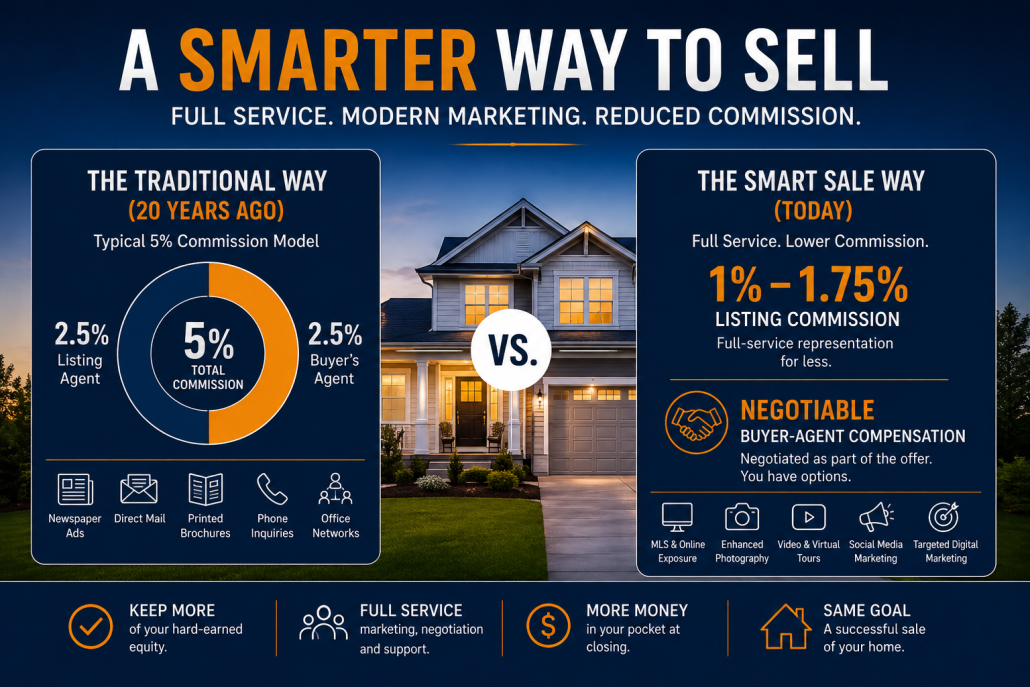
Why Pay Based on a 20-Year-Old Model?
A reduced real estate commission can make a significant difference in how much money a homeowner keeps when selling a property. For decades, a common real estate commission structure was approximately 5% of the sale price, often divided between the listing side and the buyer’s side. But real estate marketing has changed dramatically over the last 20 years. Technology, online home searches, MLS syndication, social media, enhanced photography, video, and AI have made it possible for modern brokerages to provide full-service representation much more efficiently.
So why should homeowners automatically pay commissions based on a business model developed decades ago?
The Traditional 5% Real Estate Commission Model
For many years, a common commission structure when selling a home was approximately 5% of the selling price. In a typical example, approximately 2.5% was associated with the listing side of the transaction and approximately 2.5% with the buyer’s side.
There was a reason for higher commission structures.
Twenty years ago, marketing a property often involved newspaper advertising, real estate magazines, printed brochures, direct mail, office networks, telephone inquiries, and other expensive and time-consuming methods.
The internet existed, but buyers didn’t search for homes online with anything close to the efficiency they do today.
Real estate has changed.
The commission structure doesn’t necessarily have to remain the same.
Technology Has Changed How Homes Are Sold
Today’s buyers can discover a new listing within minutes of it entering the market.
Once a home is entered into the Multiple Listing Service (MLS), property information can be distributed electronically to real estate websites and brokerage platforms. Buyers receive automated alerts matching their search criteria and can immediately view photographs, property details, maps, tax information, and other information from their phones or computers.
Social media provides another way to place properties in front of potential buyers. Digital marketing, video, enhanced photography, email, and AI-assisted listing tools allow agents to create and distribute marketing material faster than ever before.
This doesn’t mean good real estate agents are no longer valuable.
It means technology allows experienced agents to work more efficiently.
And that efficiency can make a reduced real estate commission possible without automatically reducing the level of service provided to the seller. See if you qualify for SMARTSALE.
Reduced Commission Doesn’t Have to Mean Reduced Service
This is probably the most important distinction for homeowners to understand.
Reduced commission and reduced service are not the same thing.
There are limited-service and flat-fee real estate companies that provide only certain services. That model may work for some homeowners, but it isn’t the only alternative to a traditional commission.
A modern full-service brokerage can provide services such as:
- Pricing and market analysis
- Property preparation and positioning
- Enhanced photography
- MLS listing and exposure
- Online listing syndication
- Social media and digital marketing
- Showing coordination
- Buyer and agent communication
- Offer analysis
- Negotiation
- Inspection assistance
- Appraisal coordination
- Transaction management through closing
Technology makes many of these services easier and less expensive to deliver than they were 20 years ago.
That creates the opportunity for full-service brokerages to operate under a more efficient commission model.
What Can a Reduced Listing Commission Save?
The difference between a traditional listing-side commission and a modern reduced listing commission becomes particularly noticeable as home values increase.
Consider an $800,000 home.
At a 2.5% listing commission, the listing-side commission would be:
$20,000
At a 1.75% listing commission:
$14,000
At a 1.5% listing commission:
$12,000
And at a 1% listing commission:
$8,000
Compared with 2.5%, that’s potential savings of between $6,000 and $12,000 on the listing side alone.
The question sellers should ask isn’t simply whether one percentage is lower than another.
The real question is:
What services am I receiving for the money I’m paying?
If a brokerage can provide professional, full-service representation for less, the seller may be able to keep thousands of additional dollars from the sale.
Buyer-Agent Compensation Is a Separate Conversation
Another important change in today’s real estate market is how buyer-agent compensation is handled.
The listing brokerage’s commission and the buyer agent’s compensation should be viewed as separate components of the transaction.
Buyer-agent compensation is negotiable.
Depending on the transaction, a buyer may pay their agent directly or may ask the seller to contribute toward the buyer agent’s compensation as part of their offer.
A seller can then evaluate that request along with the rest of the offer.
Instead of automatically assuming that a predetermined percentage of the selling price will go toward the buyer’s agent, sellers can consider the entire financial package being presented.
Look at the Net Proceeds of an Offer
This is where the newer compensation structure becomes particularly interesting.
Imagine receiving two offers.
Buyer A offers $800,000 and asks the seller to contribute 2% toward the buyer agent’s compensation.
Buyer B offers $790,000 and doesn’t request buyer-agent compensation from the seller.
The $800,000 offer initially appears better.
But is it?
The seller and listing agent should calculate the seller’s estimated net proceeds and consider financing, contingencies, inspection terms, closing dates, and the likelihood that each transaction will successfully close.
Buyer-agent compensation becomes another negotiable financial term of the offer.
That gives sellers an opportunity to evaluate what matters most:
How much money will I actually receive from the sale?
Higher Commission Doesn’t Automatically Mean Better Marketing
There can be a perception that paying a higher commission automatically results in better marketing.
That isn’t necessarily true.
Two brokerages could place the same property in the MLS and provide similar online exposure while charging very different listing commissions.
The important differences may instead be the quality of the presentation, pricing strategy, marketing plan, local market knowledge, responsiveness, negotiation skills, and experience of the agent handling the transaction.
Sellers should compare services—not simply commission percentages.
A reduced real estate commission only represents genuine value when it is combined with the professional services necessary to successfully market and sell the property.
Experience Still Matters
Technology can streamline real estate, but it doesn’t eliminate the need for experience.
Selling a home can involve difficult pricing decisions, multiple offers, inspection negotiations, appraisal problems, financing complications, title issues, deadlines, and unexpected problems.
An online platform can’t always solve those problems.
An experienced real estate professional can.
The opportunity created by technology isn’t to eliminate the real estate agent. It’s to allow experienced agents and brokerages to operate more efficiently while continuing to provide professional representation.
That is a very different concept from simply offering a “cheap” listing service.
Why Automatically Pay Based on the Old Model?
There is nothing inherently wrong with a traditional commission structure if the seller believes the services justify the expense.
But homeowners should understand that they have options.
If one brokerage charges approximately 2.5% on the listing side while another can provide comparable or better full-service representation for 1% to 1.75%, it’s reasonable to ask what justifies the difference.
On an $800,000 home, even a 1% difference represents $8,000.
On a $1 million home, it’s $10,000.
Homeowners routinely negotiate mortgage rates, contractor estimates, insurance premiums, and other major expenses.
Real estate commissions shouldn’t be any different.
A Modern Approach to Selling Real Estate
The way homes are marketed and sold has changed dramatically over the last 20 years.
Buyers are online. Listings are distributed electronically. Marketing can reach thousands of people quickly. Communication is nearly instantaneous. AI and digital technology continue to make the process even more efficient.
A modern real estate business model should reflect those changes.
For some homeowners, that may mean choosing an experienced full-service brokerage offering a reduced real estate commission of approximately 1% to 1.75% on the listing side while treating buyer-agent compensation separately as a negotiable component of an offer.
The objective isn’t simply to pay the lowest commission possible.
It’s to receive the service, marketing, exposure, experience, and representation necessary to achieve a successful sale—without paying more than necessary to get it.
Before listing your home, don’t simply ask what the traditional commission has always been.
Ask what you’re getting for your money.
And ask whether today’s real estate market offers a smarter alternative.
 Randy Tibbetts is an independent real estate broker providing professional residential & commercial real estate services in MA
 ADDRESS
